
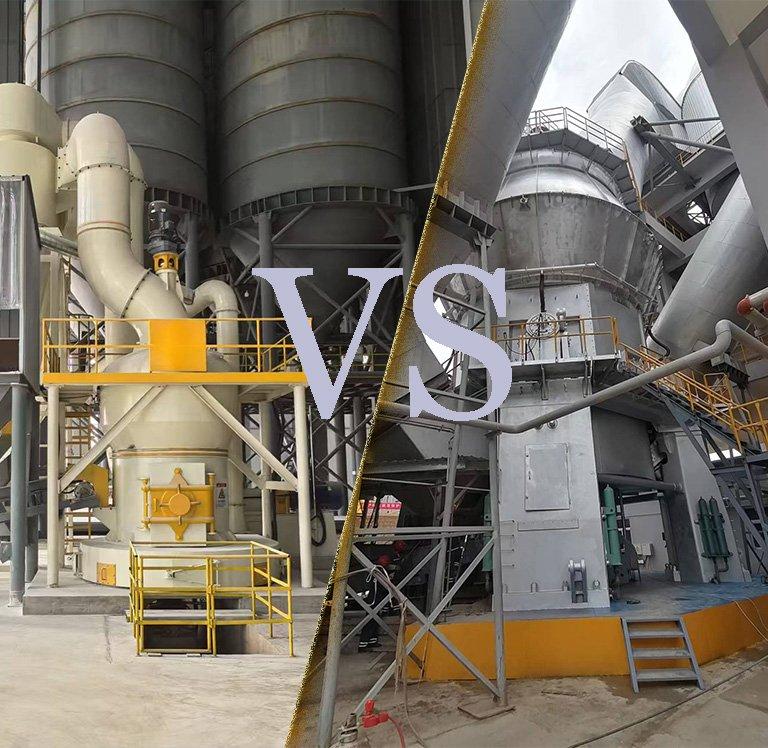
When selecting equipment for limestone grinding, two of the most common options are the Raymond mill and the vertical roller mill (VRM). Both machines are widely used in the production of limestone powder, but they differ significantly in terms of capacity, efficiency, investment cost, and application.
In this guide, we provide a detailed comparison of Raymond mills and vertical roller mills to help you choose the best solution for your limestone grinding plant.
What Is a Raymond Mill?
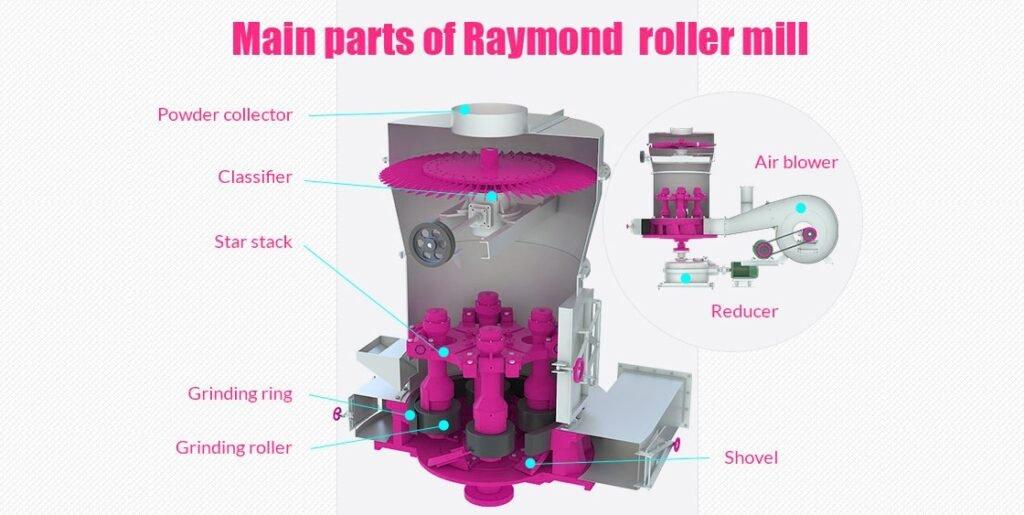
A Raymond mill (also known as a pendulum mill) is a traditional grinding machine designed for producing medium-fineness powders.
Typical Features:
- Fineness range: 80–325 mesh
- Capacity: 1–20 TPH
- Application: construction materials, basic calcium carbonate
Advantages:
- Low initial investment
- Simple structure and operation
- Easy maintenance
Disadvantages:
- Limited capacity
- Not suitable for ultra-fine powder
What Is a Vertical Roller Mill (VRM)?
A vertical roller mill (VRM) is a modern grinding system that integrates crushing, grinding, drying, and classification in one unit.
Typical Features:
- Fineness range: 80–400 mesh (customizable)
- Capacity: 10–100+ TPH
- Application: large-scale limestone grinding, FGD systems
Advantages:
- High production capacity
- Energy-efficient operation
- Automated control system
Disadvantages:
- Higher investment cost
- More complex system
Raymond Mill vs Vertical Roller Mill: Key Differences
| Factor | Raymond Mill | Vertical Roller Mill |
|---|---|---|
| Capacity | Low to medium (1–20 TPH) | Medium to large (10–100+ TPH) |
| Fineness | Up to 325 mesh | Up to 400 mesh |
| Energy Consumption | Moderate | Lower per ton |
| Investment Cost | Low | High |
| Automation | Basic | Advanced |
| Maintenance | Simple | More complex |
| Footprint | Larger layout | Compact system |
Which One Should You Choose?
Choose a Raymond Mill if:
- You have a limited budget
- Your required capacity is below 20 TPH
- You produce standard limestone powder (80–325 mesh)
- You prefer simple operation and maintenance
Choose a Vertical Roller Mill if:
- You need large-scale production (>20 TPH)
- You want higher efficiency and lower energy consumption
- You are supplying power plants (FGD) or industrial projects
- You plan for long-term investment and automation
Application Scenarios
- Small and medium factories: Raymond mill is usually sufficient
- Large industrial plants: VRM is the preferred solution
- FGD systems (power plants): VRM is highly recommended
- Calcium carbonate production: Depends on required fineness
Cost Comparison
- Raymond Mill: Lower upfront cost, suitable for startups
- VRM: Higher investment, but better long-term return due to efficiency and scale
Conclusion
There is no universal answer to which mill is better. The choice between a Raymond mill and a vertical roller mill depends on your production goals, budget, and application.
- For cost-effective, small-scale production → Raymond mill
- For high-capacity, energy-efficient operations → Vertical roller mill
By carefully evaluating your requirements, you can select the most suitable limestone grinding solution for your plant.
Need Help Choosing?
If you are unsure which machine fits your project, contact us for:
- Free material analysis
- Custom plant design
- Detailed quotation
We will help you choose the most efficient and cost-effective limestone grinding solution.
Need a Limestone Grinding Solution?
Get a free customized plant design and price quote from our engineers.
Get Free Solution →